When a Billion Chinese Jump by Jonathan Watts
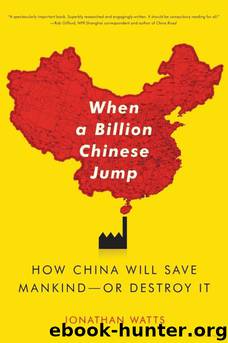
Author:Jonathan Watts [Watts, Jonathan]
Language: eng
Format: epub
Tags: Political Science, General, Public Policy, Environmental Policy
ISBN: 9781439141939
Google: GVchqY1ZaB0C
Amazon: 141658076X
Publisher: Scribner
Published: 2010-10-25T16:00:00+00:00
Northeast
Alternatives
13
Science versus Math
Tianjin, Hebei, and Liaoning
China is a country where once they realize, “Gee, we have to do
something,” then they leap forward.
—Suntech founder Shi Zhengrong, the world’s first solar billionaire
The egghead leading China’s charge toward an efficient, low-carbon future almost never made it to university. Professor Li Can grew up during the Cultural Revolution with a politically unfortunate habit: he loved to study. This went down well with his high school teachers, but, in those days, it was not much good being a top-level student if you were a second-rate revolutionary.
By 1975, the nation’s universities had been closed for almost a decade. Business was still frowned upon. For a bright young man, the only career tracks were through the Communist Party or the government. Lacking the ideological zeal for either, Li’s only choice after graduation was to return to his home in a remote corner of Gansu and become a barefoot doctor. His high school education was all the qualification he needed to perform acupuncture and rudimentary medicine around local villages near the old Silk Road.
This was a period of massive transition for China, but the changes almost passed Li by. After Mao died, a new leadership took over. Soon after, they announced the full reopening of the universities. Li did not hear about it for weeks because nobody in his village had a telephone or a radio.
Fortunately, the deputy headmaster of his old school remembered the brilliant pupil who had been forced to return to the desert, He cycled 30 kilometers to Li’s home to tell him the news and recommended he join the first wave of students to take the Gaokao entrance exam. There was barely any time to prepare and few teaching materials. In those conditions, the future head of China’s clean energy research lab did well to come forty-ninth out of 150 students in his region. None of the prestigious universities would accept him. Desperate to secure a place, he applied for a course at a second-rate university in a field he had little interest in.
“I chose chemistry. To be honest, it was not my favorite subject. I had always preferred math and literature, but I thought I would have more chance of securing a place with chemistry. You cannot understand what it was like then.”1
I had a soft spot for Li’s generation. The wave of university students who came of age as the country removed the ideological blinkers of the Cultural Revolution tended to be more open-minded, down-to-earth, and appreciative of education than others. “I can still do acupuncture,” the former barefoot doctor said with a smile as he poured a fresh cup of green tea. He had come a long way from curing desert villagers with traditional medicine.
We were sitting in Li’s spacious study in the Dalian National Laboratory for Clean Energy. The research center had just been established to spearhead China’s efforts to escape the energy crunch and ease the risks of global warming. Li was the first head. He was engaging company. As he talked about the future of China, the world, and energy, it was clear he had huge ambitions.
Download
This site does not store any files on its server. We only index and link to content provided by other sites. Please contact the content providers to delete copyright contents if any and email us, we'll remove relevant links or contents immediately.
| Anthropology | Archaeology |
| Philosophy | Politics & Government |
| Social Sciences | Sociology |
| Women's Studies |
The Secret History by Donna Tartt(19142)
The Social Justice Warrior Handbook by Lisa De Pasquale(12199)
Thirteen Reasons Why by Jay Asher(8931)
This Is How You Lose Her by Junot Diaz(6903)
Weapons of Math Destruction by Cathy O'Neil(6292)
Zero to One by Peter Thiel(5818)
Beartown by Fredrik Backman(5775)
The Myth of the Strong Leader by Archie Brown(5518)
The Fire Next Time by James Baldwin(5460)
How Democracies Die by Steven Levitsky & Daniel Ziblatt(5230)
Promise Me, Dad by Joe Biden(5161)
Stone's Rules by Roger Stone(5097)
A Higher Loyalty: Truth, Lies, and Leadership by James Comey(4975)
100 Deadly Skills by Clint Emerson(4938)
Rise and Kill First by Ronen Bergman(4807)
Secrecy World by Jake Bernstein(4764)
The David Icke Guide to the Global Conspiracy (and how to end it) by David Icke(4732)
The Farm by Tom Rob Smith(4519)
The Doomsday Machine by Daniel Ellsberg(4499)
